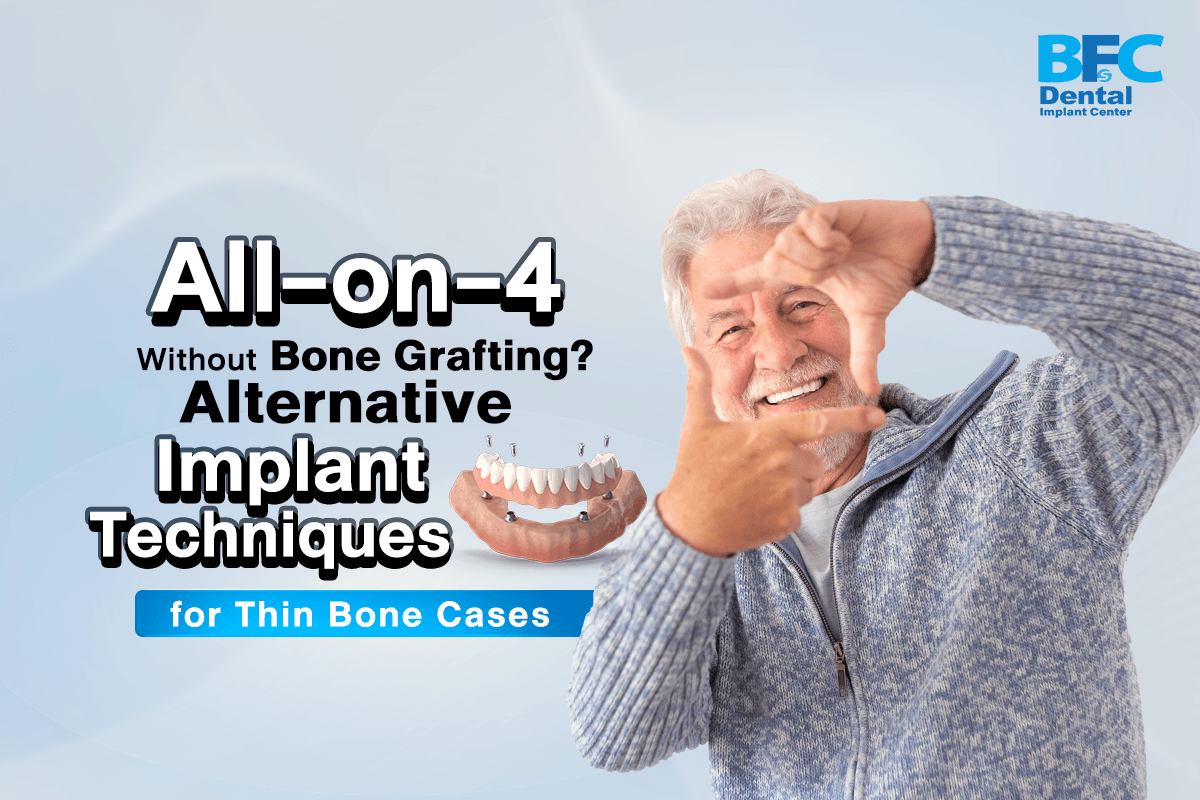
Losing most of your teeth is a profound blow to your wellbeing in which affecting how you eat, speak, and present yourself to the world. For many people, full mouth dental implants seem like the obvious solution. Then comes the consultation, and the dentist delivers discouraging news: your bone is too thin for standard implants.
The thought of undergoing a bone graft surgery is painful, expensive, and followed by months of waiting before implants can even begin in which enough to make many patients abandon hope entirely.
Before you do that, read this. At BFC Dental Implant Center, we use specialized implant techniques that allow many thin-bone patients to receive a full new set of strong, functional teeth immediately without bone grafting and without a lengthy treatment timeline.
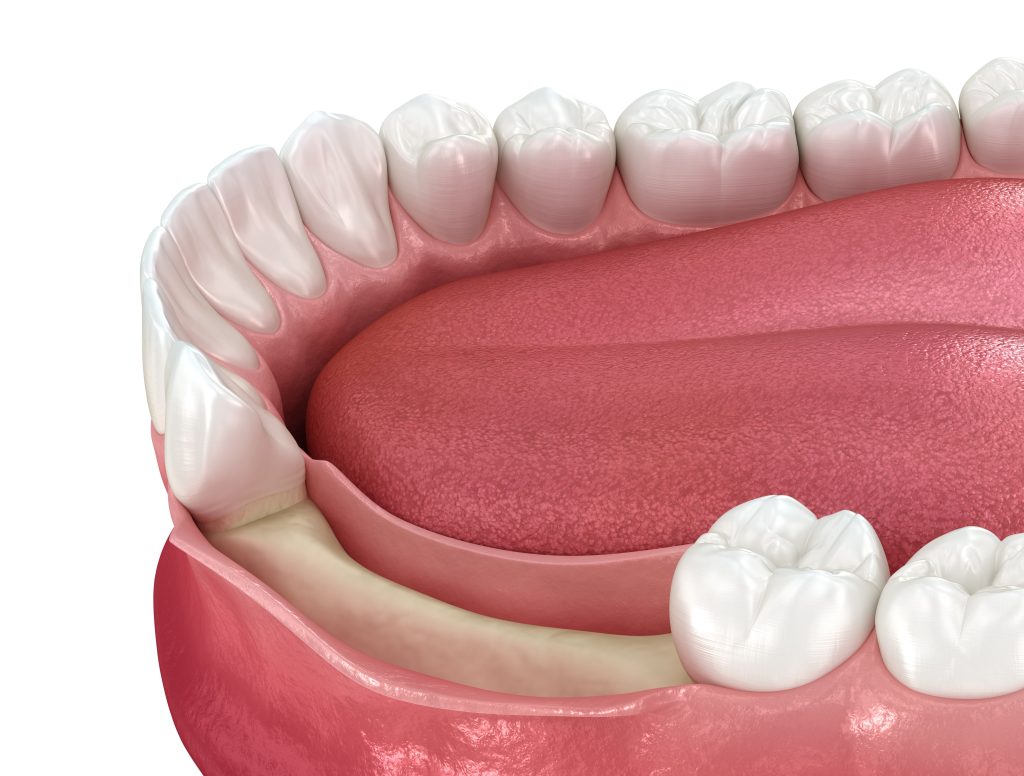
Why Does the Jawbone Become Too Thin?
Understanding why bone resorption happens helps explain why the problem is so common and why it is not always the obstacle it appears to be.
- Long-term tooth loss: Without natural tooth roots transmitting chewing forces into the jaw, the bone receives no stimulation. The body begins to resorb it; the ridge gradually shrinks in both height and width.
- Long-term use of removable dentures: Dentures rest directly on the gum and bone. The pressure of chewing through a denture actually accelerates bone resorption, meaning the longer someone wears a denture, the worse the bone loss becomes.
- Chronic periodontal disease: Bacterial infection of the gum and root-supporting structures directly destroys the alveolar bone around each tooth, causing widespread bone loss even before teeth are extracted.
- Sinus pneumatization (upper jaw): After upper back teeth are lost, the maxillary sinuses naturally expand downward into the space previously occupied by tooth roots. This reduces the available bone height in the upper jaw to almost nothing.
Can You Still Get All-on-4 Full Mouth Implant with Very Little Bone?
This is the question every thin-bone patient wants answered: if my bone is severely depleted, can I still get All-on-4 without a bone graft?
For many patients, the answer is yes. The key lies not in adding bone, but in finding the bone that is still there, bone in locations that are dense, stable, and completely unaffected by tooth loss.
Alternative Implant Placement Techniques for Thin-Bone Cases
Technique 1: Pterygoid Implant
The Pterygoid Implant technique is ideal when the posterior upper jaw has severe bone loss combined with a drooping sinus floor.
The dentist uses a specially designed, extended-length implant and angles it through the Maxillary Tuberosity (the rounded back edge of the upper jaw) to anchor deep into the Pterygoid Plate, a region of dense cortical bone at the base of the skull. This bone is structurally independent of the tooth-bearing ridge and does not resorb, regardless of how long teeth have been missing.
Why this works so well: cortical bone in the Pterygoid region provides immediate, strong fixation right from the moment the implant is placed. This allows the dentist to load a temporary fixed bridge within 24 hours of surgery (Immediate Loading), so patients leave the clinic with usable teeth the same day.
Technique 2: Palatal Approach
When the front ridge of the upper jaw is too thin to accept a conventionally placed implant, the Palatal Approach offers an elegant solution.
Rather than placing the implant straight down through the thin outer ridge, the dentist adjusts the implant angle to engage the palatal bone, the dense bone of the roof of the mouth. This area typically retains substantially more bone volume and density than the outer ridge, even in cases of severe resorption.
Why this works: the palatal bone provides a firm anchor, reducing the risk of the implant perforating the thin outer wall. And just like the Pterygoid technique, it supports Immediate Loading, the patient receives a fixed temporary bridge within 24 hours.
Safe, Precise, and Fast: The Full Digital Workflow
Thin-bone cases demand a higher level of precision than standard implant cases. At BFC Dental Implant Center, every complex case is planned and executed using our complete Full Digital Workflow:
- 3D CBCT Planning
Cone-beam CT imaging maps bone width, height, and density throughout the jaw. Digital software calculates the optimal implant position, angle, and depth, keeping safe margins from the sinus cavities and nerve pathways.
- 3D Surgical Guide
A custom-printed 3D Surgical Guide is used during the operation. It physically constrains the drill to the planned angle and position, eliminating estimation errors. The guide also enables a minimally invasive approach: smaller incisions, less post-operative swelling, and a faster recovery.
- In-House Laboratory with CAD/CAM and 3D Printing
BFC Dental’s in-house laboratory uses CAD/CAM design and 3D printing to fabricate the temporary fixed bridge before surgery day. This is what makes 24-hour delivery possible, the bridge is ready and waiting when surgery is complete.
Final Thoughts: Thin Bone Is No Longer a Dead End
If you have been discouraged by a diagnosis of severe bone loss or told that you need a bone graft before implants, there is genuine reason for hope. The combination of All-on-4 treatment with Pterygoid and Palatal implant techniques has given thousands of thin-bone patients a strong, stable, natural-looking smile without the pain, cost, and waiting time of bone graft surgery.
The first step is a thorough consultation and 3D bone assessment. Contact BFC Dental Implant Center today to find out whether these techniques are right for your case. We are ready to design a new smile that is strong, beautiful, and built to last.