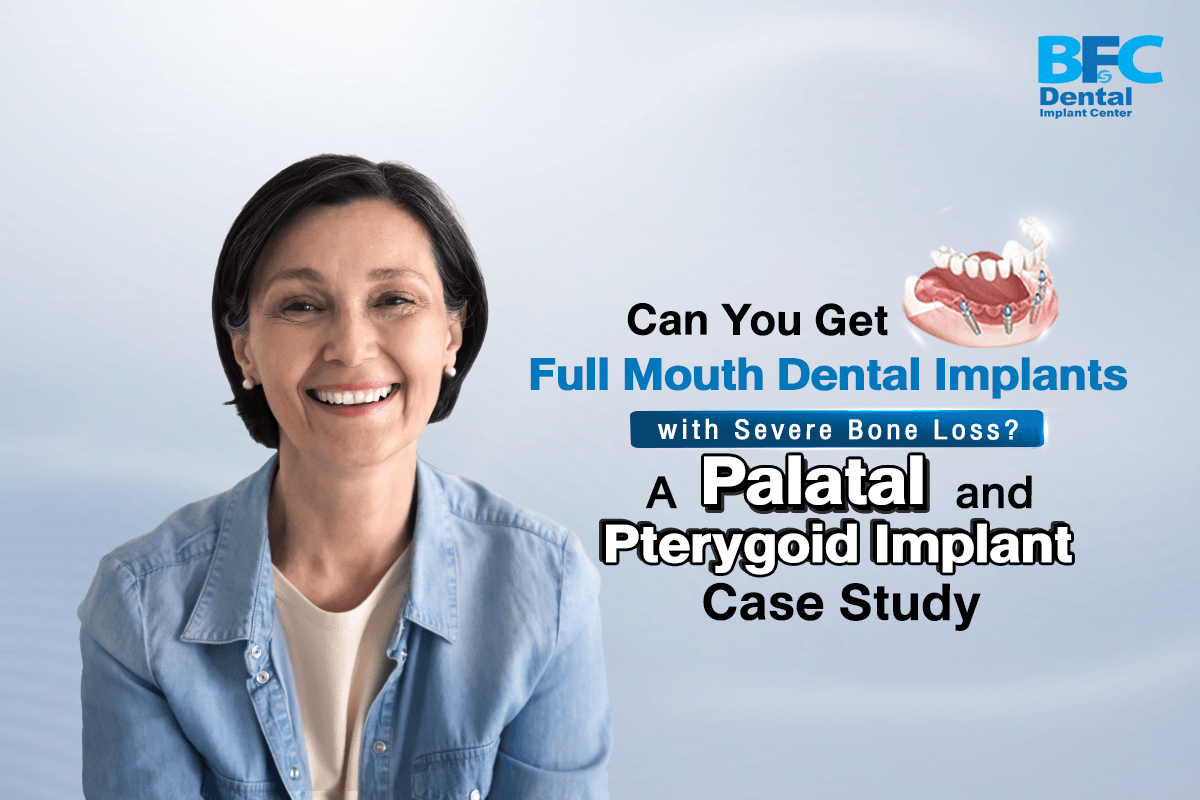
Do you hide your smile behind your hand? Does every meal become a challenge because of sore gums and loose teeth? Have you been told your jawbone is too thin for dental implants? You are not alone and the situation may not be as hopeless as you think.
At BFC Dental Implant Center, we see patients every day who arrive convinced there is no solution. In this article we walk through a real patient case involving severe gum disease, dramatic bone loss, and a collapsing bite and show exactly how our team restored a full, natural-looking smile using the Palatal and Pterygoid Implant technique, without bone grafting or sinus lifting.
Why Bone Loss Makes Full Mouth Implants Difficult
In a standard full mouth implant procedure, the dentist places implants vertically through the centre of the jawbone ridge. This only works when the bone has sufficient density and volume to anchor the implant securely.
When natural teeth are lost for a long time or when advanced periodontal (gum) disease is present, the jawbone gradually resorbs and shrinks. In the upper jaw, the problem is compounded by the sinuses, which tend to expand downward once there are no tooth roots to hold them back.
Traditionally, patients in this situation faced two major surgeries before implants could even begin: a sinus lift and a large-scale bone graft. Both procedures are invasive, painful, expensive, and require months of healing before implant placement can start.
Is there a better way? At BFC Dental Implant Center, the answer is yes.
This Patient’s Case: Complex Bone Loss and Facial Changes
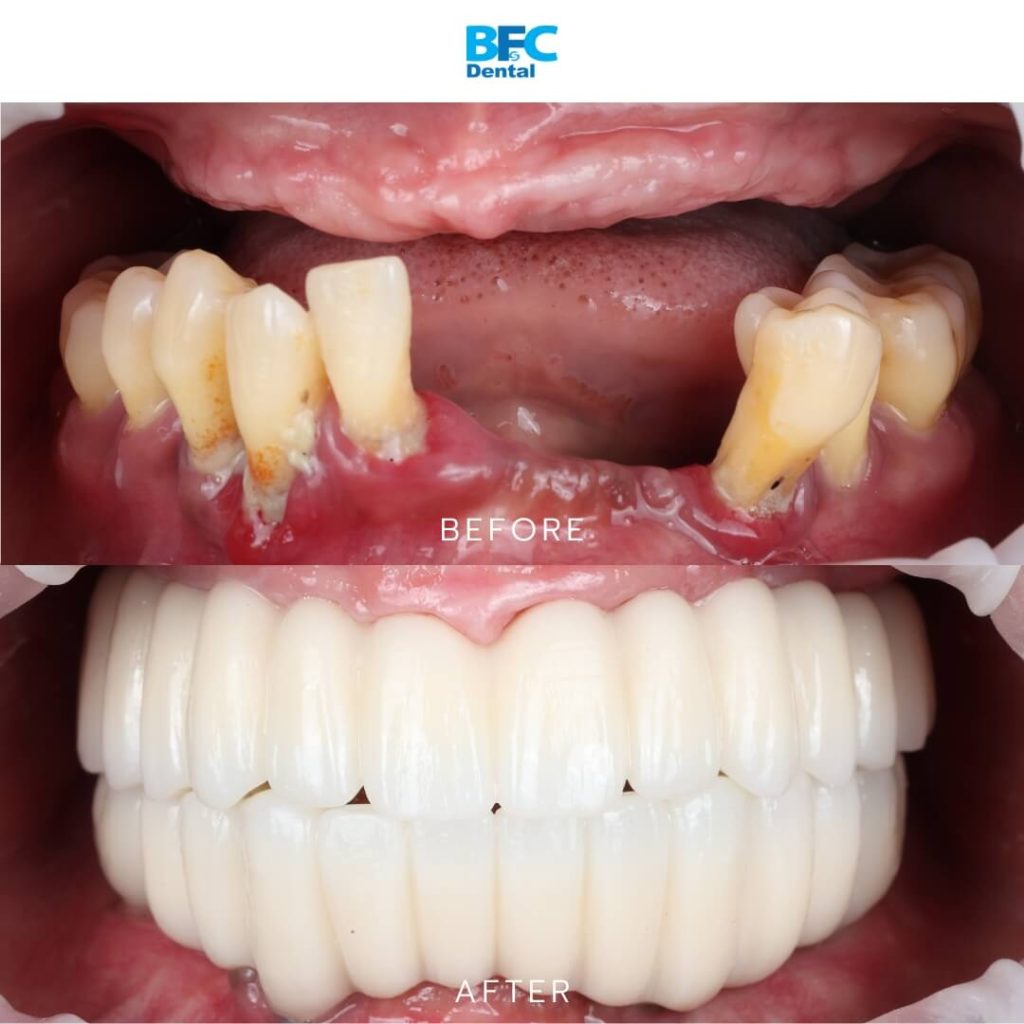
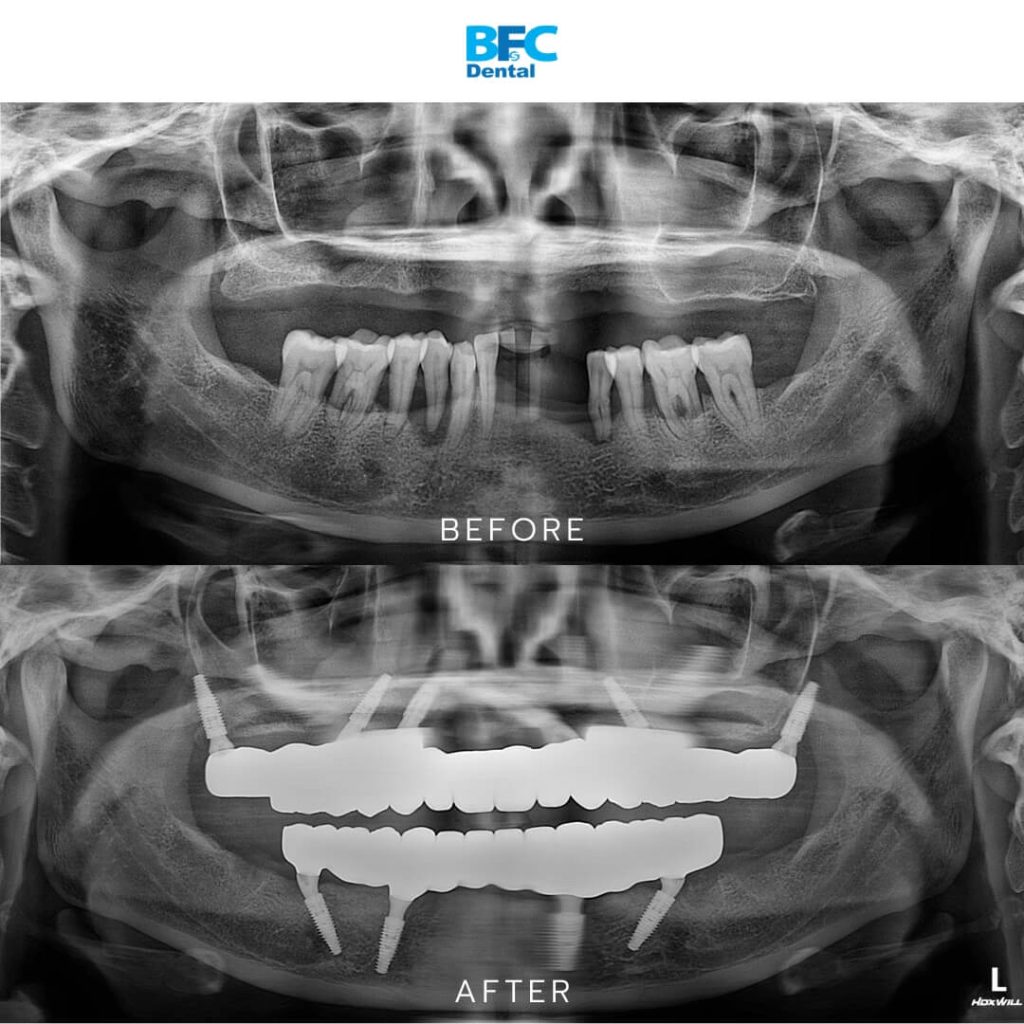
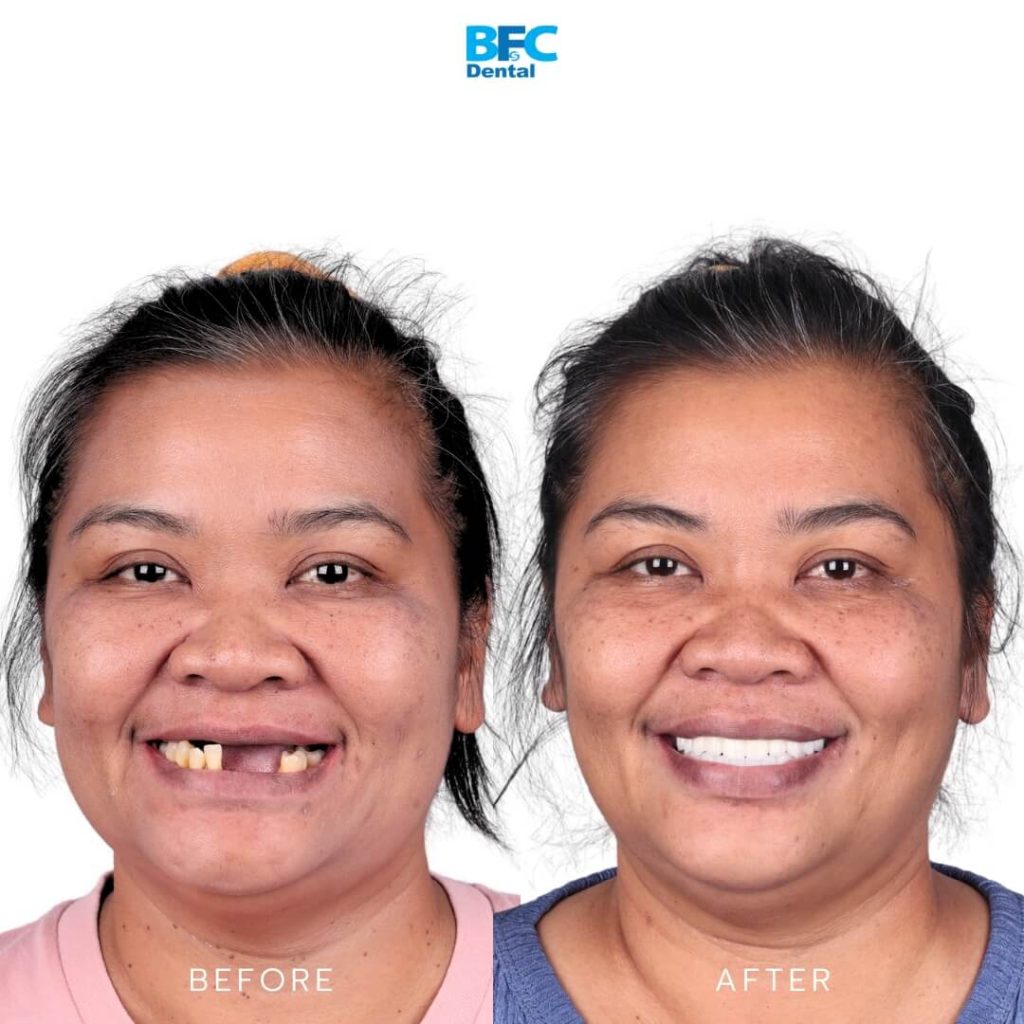
The patient arrived at BFC Dental clinic with serious concerns. Her remaining natural teeth were dangerously loose and she had significant difficulty chewing. The upper jaw had undergone severe bone resorption, leaving almost no ridge height to work with.
Tooth and bone loss had already begun to change her facial appearance. The lower third of her face had collapsed inward, her lips appeared thin and deflated, and the corners of her mouth had dropped — all classic signs of severe bone loss. She had lost her confidence to smile or socialise.
The Solution: Palatal and Pterygoid Implant Technique
Our specialist team at BFC Dental chose the Palatal and Pterygoid Implant technique which is a fully digital, guided approach that bypasses the problem areas entirely.
A total of six implants were placed in the upper jaw and four in the lower jaw. A 3D Digital Surgical Guide ensured pinpoint accuracy for every implant, minimising incision size, reducing swelling, and accelerating recovery.
Technique 1: Palatal Approach
Where the front ridge bone is too thin, the implant angle is shifted toward the palatal (roof-of-mouth) side rather than being placed straight down through the ridge. The dense palatal bone provides immediate, strong fixation even when the outer ridge has resorbed.
Technique 2: Pterygoid Implant
Where the rear of the upper jaw has a drooping sinus, a specially lengthened implant is angled deep into the Pterygoid Plate, a section of dense cortical bone at the base of the skull that is unaffected by tooth loss. This bone never resorbs, providing outstanding long-term stability with no need for sinus surgery or bone grafting.
New Teeth in Just 24 Hours
Immediately after surgery, the patient received a fixed temporary bridge made from premium acrylic (FP1 design) within 24 hours. Unlike conventional full-arch bridges, the FP1 design has no bulky pink artificial gum, meaning the patient could speak naturally and begin eating soft foods right away.
After six months, once osseointegration (bone-to-implant fusion) was complete, the temporary bridge was replaced with a final Zirconia ceramic FP1 bridge: strong, translucent, stain-resistant, and virtually indistinguishable from natural teeth.
More Than New Teeth: A New Quality of Life
- Natural-looking smile: No pink gum base, seamless gum-to-tooth transition, no one can tell they are implants.
- Preserved bone: Implants stimulate the jaw exactly like natural roots, halting further bone resorption.
- Restored facial balance: Corner of the mouth lifted, perioral wrinkles softened, overall appearance refreshed and more youthful.
- Immediate function: Speaking and soft-food chewing possible within 24 hours of surgery.
Don’t Let Severe Bone Loss Stop You
Many patients are told they are not candidates for dental implants because of advanced bone loss. However, modern implant dentistry continues to evolve. Advanced techniques such as Palatal Implants and Pterygoid Implants have made fixed full mouth dental implants possible for many patients who previously had very limited treatment options.
At BFC Dental Implant Center, our experienced implant team uses advanced digital planning, guided surgery, and specialized implant techniques to help patients restore their smiles even in complex cases involving severe bone loss. If you have been told that your bone is too thin for dental implants, a consultation may reveal options you never knew existed.
Frequently Asked Questions
Q1: Why does severe gum disease cause such dramatic bone loss?
Two main factors are at work. First, once natural tooth roots are gone, the jawbone no longer receives the chewing stimulation it needs and begins to resorb. Second, chronic periodontal (gum) disease allows bacteria to directly destroy the alveolar (tooth-socket) bone, causing resorption both vertically and horizontally, often invisibly until the bone loss is severe.
Q2: What makes the FP1 bridge design different from a standard full-arch bridge?
An FP1 bridge comprises only the teeth themselves, sitting directly on the patient’s real gum tissue. There is no thick pink acrylic gum base to cover the gums. The result is a lighter, slimmer prosthesis that feels more natural, is easier to clean, and looks seamless at the gum line.
Q3: Why is the Pterygoid Plate a better anchor points than the jaw ridge?
The alveolar ridge (normal jaw bone) shrinks after tooth loss. The Pterygoid Plate — part of the sphenoid bone at the skull base is dense cortical bone that is structurally independent of the teeth. It does not resorb, making it a safe, durable, and load-bearing anchor point for long-term implant success.
If you have been told your bone is too thin for implants, do not give up. Contact BFC Dental Implant Center for a comprehensive consultation. We have the technology and experience to find the right solution for even the most complex cases.