Key Takeaways: Full Mouth Dental Implants with Palatal and Pterygoid Techniques
- Flared, loose front teeth are directly caused by severe gum disease destroying the bone that anchors them, forcing teeth forward and distorting the lip line.
- Warning signs like bleeding gums, recession, bad breath, drifting teeth, and mobility are signals that bone loss is already well underway.
- The All-on-4 procedure using Pterygoid and Palatal implant techniques allows many patients with severe bone loss to receive stable implants immediately, no bone grafting required.
- The gum-free FP1 bridge design delivers the most natural-looking result, is lighter and easier to clean than traditional full-arch bridges.
Have you noticed that your face or lips look different than they used to? Many people assume the change is simply ageing or a loss of skin firmness. The truth is that your teeth and jawbone are the primary structural scaffolding of your lower face. When that foundation weakens, the visible changes can be dramatic.
In this article we explore a real patient case from BFC Dental Implant Center: a patient with whole-mouth loose teeth, severe bone resorption, and a visibly altered face profile. We show how the team corrected everything using pterygoid and palatal implant techniques without bone grafting, without a lengthy wait, and without the collapsed smile she had been living with.
How Gum Disease Changes Your Bite and Facial Appearance
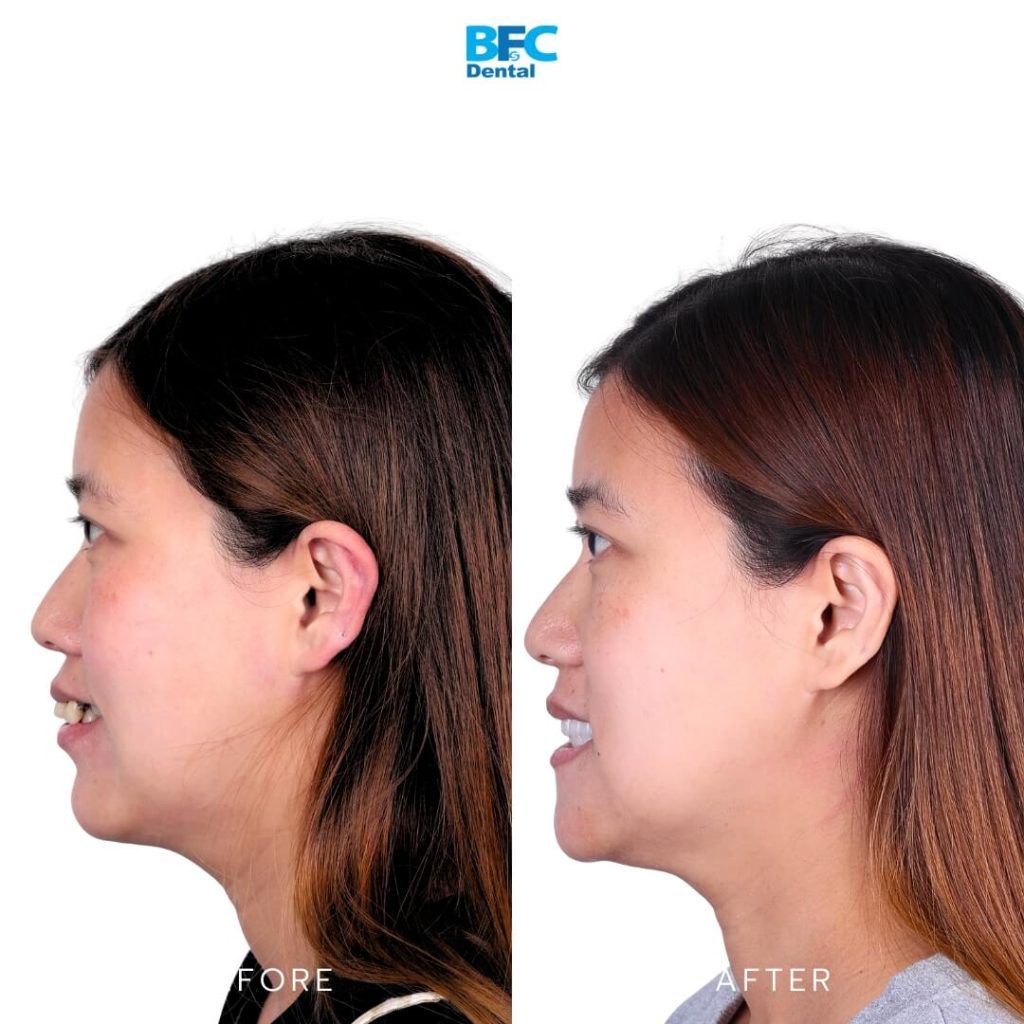
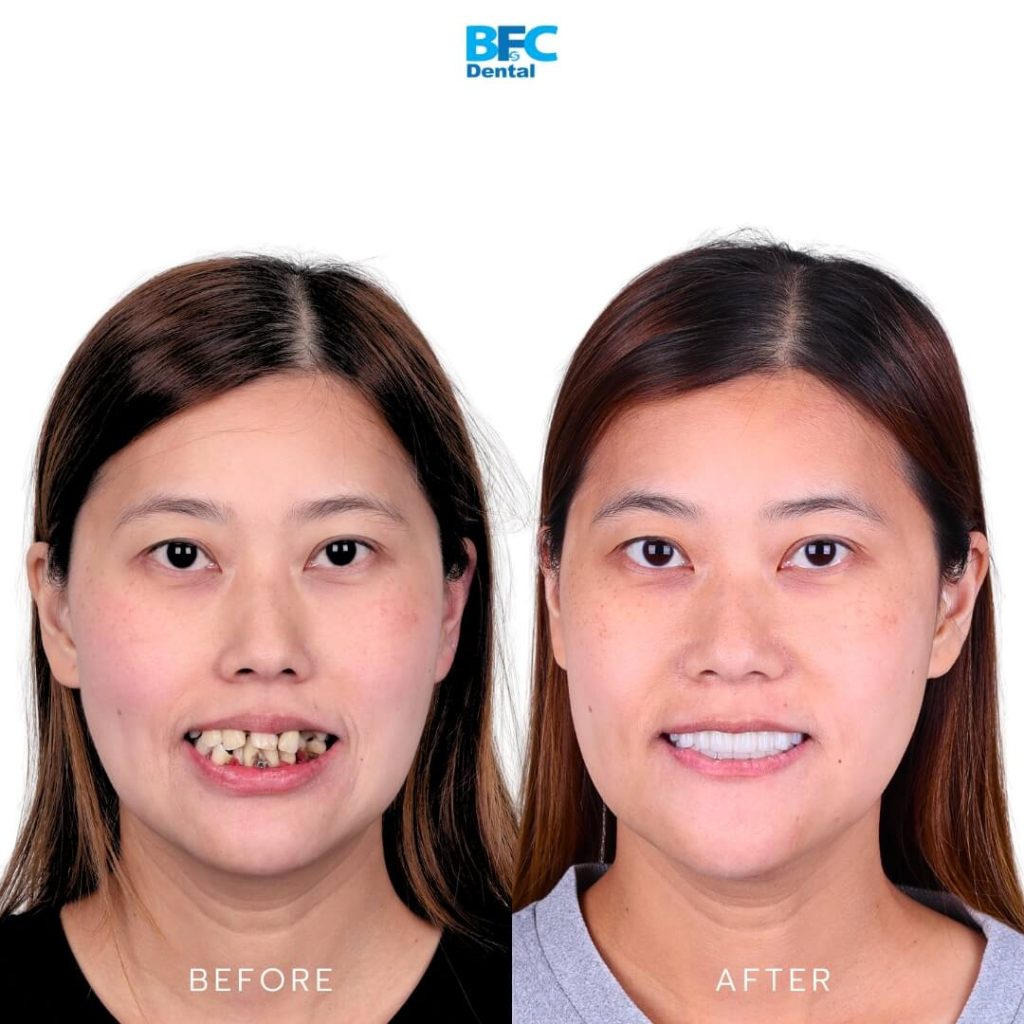
Looking at the patient’s pre-treatment photographs, her upper lip visibly protruded, making her facial profile appear unbalanced. The root cause was tooth movement driven by severe, long-standing gum disease.
As periodontal disease silently destroys the alveolar bone surrounding each root, the teeth lose their foundation. Without that support they can no longer resist the natural pressures of chewing and tongue force. The front teeth begin to flare forward, press against the upper lip, and push it outward. At the same time the patient’s bite collapses: upper and lower teeth no longer meet properly, making normal chewing impossible and placing enormous strain on the jaw joints.
Warning Signs of Advanced Gum Disease
Many people dismiss early gum inflammation as trivial, it will go away on its own. It rarely does. Here are the warning signs that periodontal disease has progressed to a serious stage:
- Bleeding when brushing or flossing: Gums appear dark red, swollen, and have lost their firm, stippled texture.
- Persistent bad breath: A strong odour that does not resolve with brushing, caused by bacteria and calculus (tartar) accumulating deep in the gum pockets.
- Receding gums: Teeth appear longer than before; the root surface or even the root tip may be visible. Pus occasionally seeps from the gum sulcus.
- Drifting and spacing: Front teeth begin to flare, tilt, or shift; the bite feels different from how it used to.
- Tooth mobility: Teeth move noticeably when you bite down, chew, or push them with your tongue.
The insidious nature of periodontal disease is that early bone destruction happens silently beneath the gum surface, with minimal pain. By the time most patients seek care, they have already lost more than half of the bone supporting their teeth.
How Serious Was the Bone Loss in This Case?
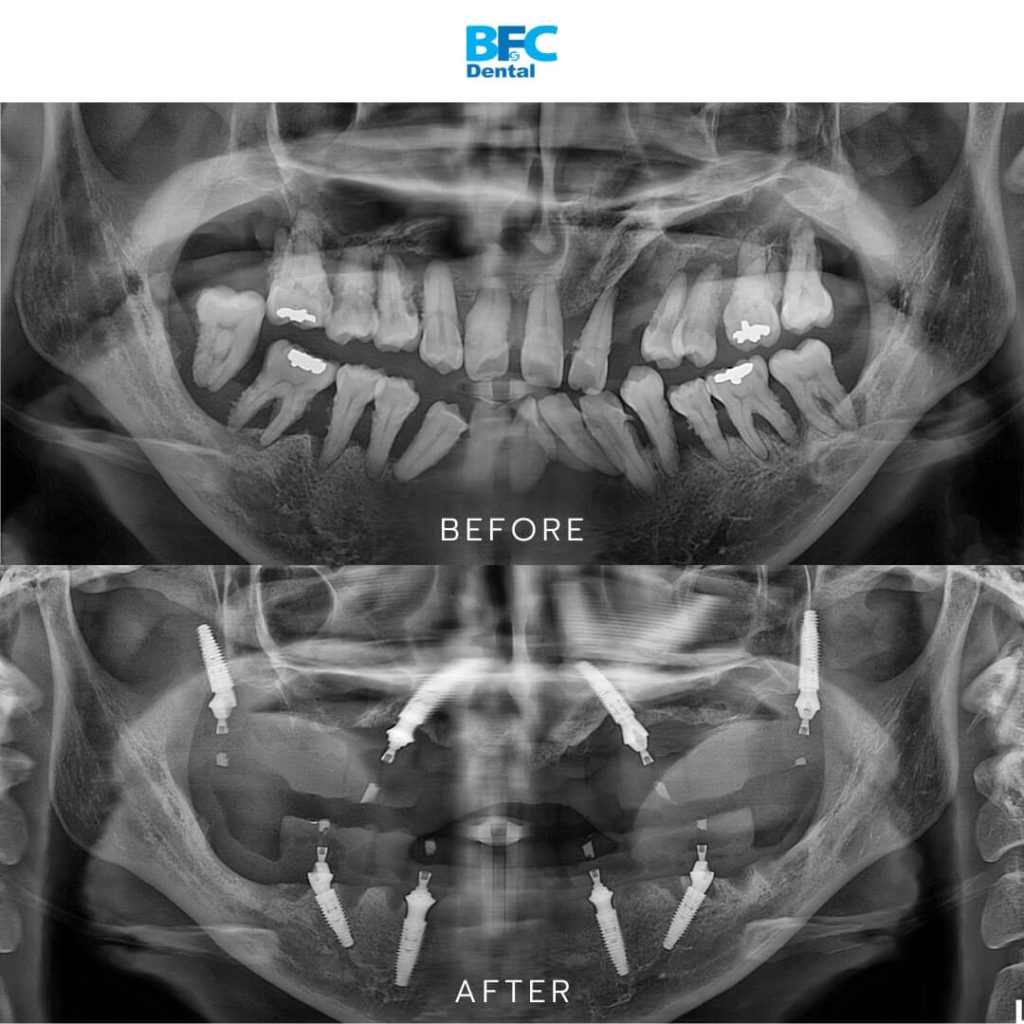
In this patient’s X-rays, bone loss around nearly every tooth root was visible and severe. The roots were effectively floating in soft tissue with almost no solid bone anchorage — explaining the whole-mouth mobility, difficulty chewing, and misaligned bite. A conventional full mouth implant procedure was not possible without first addressing the bone deficiency, which would normally mean a major bone graft surgery and a waiting period of many months.
The Solution: All-on-4 with Pterygoid and Palatal Implant Techniques
To bypass the bone loss limitation, BFC Dental’s specialist team selected a combination of two advanced implant placement techniques, avoiding the need for bone grafting entirely.
Palatal Approach
Instead of placing implants straight down through the thin front ridge, the dentist angles them toward the palatal (roof-of-mouth) side. The palatal bone retains higher density and volume even after years of tooth loss giving the implant an immediate, strong grip.
Pterygoid Implant
Long-body implants are angled into the Pterygoid Plate, a dense section of skull-base cortical bone located at the posterior upper jaw. This bone is completely independent of the tooth-bearing ridge and does not resorb. It provides an excellent long-term anchor while completely avoiding the sinus cavity, eliminating any need for a sinus lift procedure.
The treatment plan for this case was executed entirely through a digital workflow for maximum safety and accuracy:
- Four upper jaw implants placed using Palatal plus Pterygoid techniques.
- Four lower jaw implants placed using the standard tilted approach.
- Fixed temporary acrylic bridge (Ivoclar premium material, FP1 gum-free design) fitted within 24 hours of surgery which allowing the patient to smile, speak, and eat soft foods with confidence immediately.
- After 4 to 6 months of osseointegration, the temporary bridge is upgraded for a final full-arch Zirconia ceramic bridge for long-term strength and aesthetics.
Why the FP1 Bridge Design Delivers the Most Natural Result
Not all full-arch bridges look the same. The choice of bridge design significantly impacts both appearance and comfort. For this case, the dental team chose the FP1 design which is the most natural-looking option available.
An FP1 bridge contains only the teeth. There is no pink acrylic gum base between the teeth and the patient’s own gum tissue. The bridge sits directly on the real gums, creating a seamless, natural gum line that is indistinguishable from natural teeth. Because there is no bulky gum flange, the bridge is also thinner, lighter, more comfortable, and far easier to clean than the traditional FP3 design, which carries a thick pink gum section that can trap food debris and bacteria.
After treatment, the patient’s new teeth corrected her bite, allowed her upper lip to rest in its natural position, restored facial profile balance, and gave her back the confidence that advanced gum disease had taken away.
Bone Loss Is Not Always a Dead End
Even with severe bone resorption, whole-mouth mobility, and a visibly collapsed facial structure, full mouth restoration is achievable with the right technique and the right team. If you or someone you love is struggling with loose teeth, gum disease, or changes in facial appearance, do not give up hope. Contact BFC Dental Implant Center for a thorough consultation — we are here to help you reclaim your smile and your quality of life.