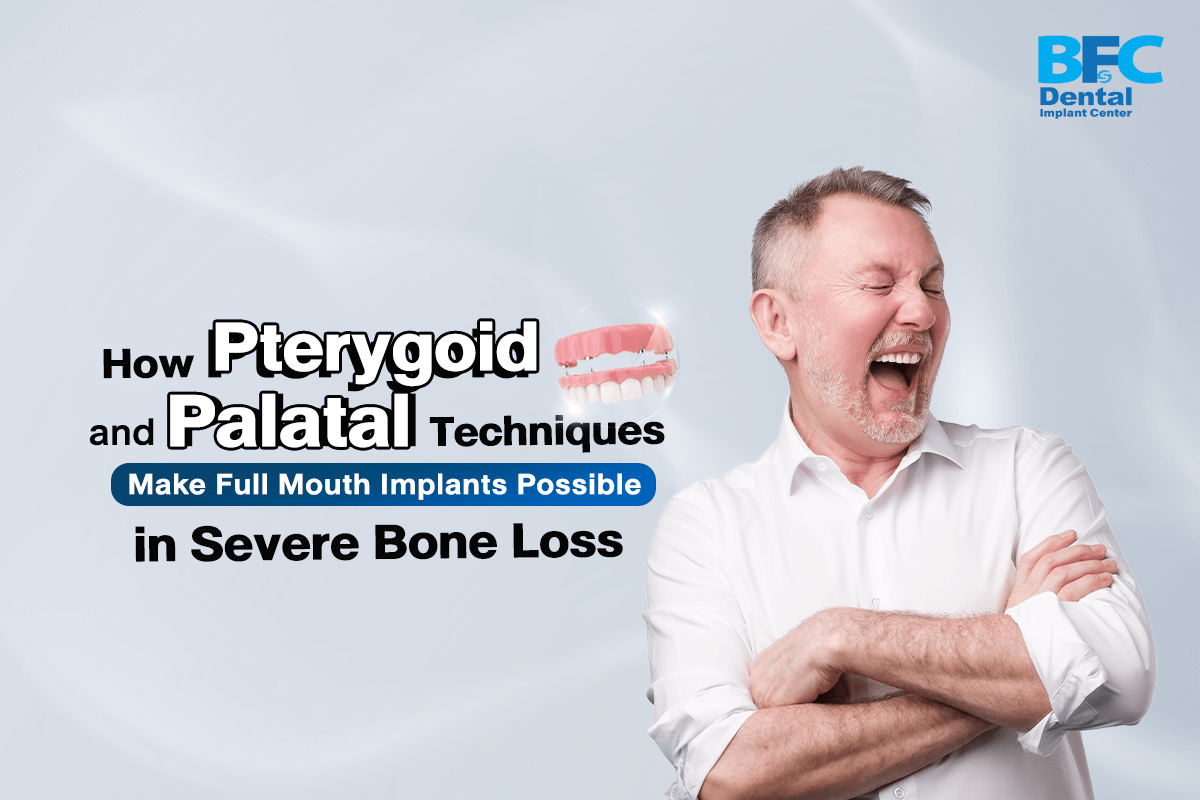
“Your jawbone is too thin. Dental implants aren’t possible, or if we proceed, you’ll need bone grafting and must wait at least a year.” This devastating diagnosis crushes the hopes of countless people who have lost multiple teeth or require full mouth restoration, particularly those experiencing significant jawbone resorption. However, advanced Pterygoid and Palatal Approach techniques at Thailand Dental Implant Center now make full mouth dental implants achievable, creating strong, beautiful smiles immediately even when bone volume seems impossibly inadequate.
Why Severe Bone Loss Creates Major Obstacles for Dental Implants
The classic challenge facing patients who have lived without natural teeth for extended periods centers on progressive bone deterioration. The upper jaw experiences predictable resorption patterns: the bone shrinks vertically upward and collapses inward horizontally. Simultaneously, the sinus cavity expands downward, claiming space previously occupied by bone. This leaves the alveolar ridge measuring just a few millimeters in thickness, creating what appears to be an impossibly thin foundation.
Traditional solutions involve bone grafting and sinus lift procedures, which carry inherent risks and require many months before the augmented bone becomes suitable for implant placement. The waiting period alone discourages many patients, not to mention the additional surgical procedures, costs, and uncertainty about outcomes.
Modern techniques offer a fundamentally different approach. Rather than attempting to create new bone where it has disappeared, skilled dental surgeons identify existing natural bone with superior density hidden in deeper, stronger anatomical locations. Specifically, the pterygoid bone in the posterior region and the palatal bone in the anterior area provide robust anchorage points that conventional techniques often overlook.
Pterygoid Approach: Accessing the Skull Base for Unshakeable Stability
The Pterygoid Approach involves placing implants at an angle to engage the pterygoid plates, which form part of the sphenoid bone at the skull base. This bone structure sits deep behind the upper nasal cavity, offering exceptional density and strength far superior to the thin alveolar ridge bone that traditional vertical placement would require.
By anchoring implants in this deep cortical bone, dentists bypass the compromised ridge entirely. The technique elegantly avoids the sinus cavity, eliminating risks of sinus perforation or infection while removing the need for sinus lift procedures. In many cases, bone grafting becomes completely unnecessary, dramatically simplifying treatment.
Advantages of Pterygoid Implant Placement
This technique creates posterior support for the dental bridge without requiring cantilevered extensions, meaning your new teeth receive support all the way back to the molar region. This comprehensive support significantly extends the lifespan of the restoration and distributes chewing forces more naturally across the entire arch.
Patients with severe posterior bone loss who would traditionally face extensive grafting can now receive implants without sinus lifts or supplemental bone augmentation. This reduces surgical steps, shortens treatment timelines, and minimizes complications. The balanced force distribution proves especially valuable for patients missing all posterior teeth, restoring chewing function that closely approximates natural dentition while preserving long-term bone structure in the upper jaw.
Palatal Approach: Utilizing the Roof of Your Mouth for Anterior Stability
The Palatal Approach modifies implant angulation in the upper arch, directing placement toward the palatal bone rather than straight down through the center of the thin ridge. The palate, forming the roof of your mouth, typically retains substantially more bone thickness and density compared to the facial (cheek) side of the ridge.
By angling implants toward this palatal bone, surgeons achieve secure anchorage in strong existing bone rather than struggling with inadequate ridge dimensions. This positioning reduces sinus perforation risks and frequently eliminates bone grafting requirements altogether.
Benefits of the Palatal Technique
Treatment timelines shorten considerably when bone grafting and sinus surgery become unnecessary. Patients experience faster recovery, returning to normal function within days rather than months. Many cases qualify for immediate loading protocols, where temporary bridges attach to the implants during the same surgical appointment. Because the implants engage dense natural bone from the outset, they provide sufficient stability to support functional and aesthetic prosthetics immediately.
Combined Pterygoid and Palatal Approaches: Comprehensive Solutions for Complex Cases
Integrating both Pterygoid and Palatal techniques allows dental surgeons to develop successful treatment plans for patients previously deemed unsuitable candidates for implants due to bone limitations. In numerous cases, supplemental bone grafting becomes completely unnecessary. Patients receive their new teeth faster, undergo fewer surgical procedures, experience shorter recovery periods, and return to normal daily activities quickly.
The resulting restorations demonstrate exceptional strength, stability, and longevity. Clinical research confirms high success rates for these advanced angulation techniques, providing confidence that outcomes will prove reliable over decades of use.
Advanced Technology Requires Specialized Expertise
Successfully implementing pterygoid and palatal implant placement demands sophisticated treatment planning, advanced imaging technology, and surgical precision. Three-dimensional CT scanning allows surgeons to map bone anatomy with submillimeter accuracy, identifying optimal implant positions and angles before surgery begins. Computer-guided surgical protocols ensure that planned positions translate accurately during the procedure itself.
The anatomical knowledge required for these techniques extends beyond routine implant dentistry. Pterygoid implants engage bone structures near critical neurovascular elements and sinus boundaries, demanding thorough understanding of complex facial anatomy. Similarly, palatal placement requires careful planning to achieve proper angulation without compromising nasal structures or creating prosthetic complications.

Restoring More Than Just Teeth
For patients facing severe bone loss who previously received discouraging diagnoses, these advanced techniques represent genuine hope. Treatment need not end in disappointment or resignation to inadequate dentures. The Pterygoid and Palatal Approach methods available at Thailand Dental Implant Center enable personalized treatment designs that restore confident smiles and elevated quality of life.
The transformation extends beyond mechanical tooth replacement. Patients regain the ability to eat nutritious foods without restriction, speak clearly without denture movement, and smile genuinely without self-consciousness. The psychological benefits of secure, attractive teeth often prove as valuable as the physical restoration itself.
Your Path Forward
If you’re confronting jawbone deterioration that seems to preclude dental implants, don’t accept defeat. Advanced surgical techniques have evolved dramatically, and conditions that appeared hopeless just years ago now respond to sophisticated treatment approaches. Consultation with experienced implant specialists can reveal options you didn’t know existed, potentially offering solutions that restore both function and confidence without the delays and complications of extensive bone grafting.
Wondering if advanced implant techniques can help your specific situation? Contact Thailand Dental Implant Center today for a comprehensive evaluation. Our specialists will assess your bone structure, explain your options clearly, and design a personalized treatment plan that may include pterygoid and palatal techniques to achieve the stable, beautiful smile you deserve.