One of the greatest advances in modern implant dentistry is the integration of digital technology into every stage of treatment. While the success of All-on-4 full mouth dental implants depends on the experience and expertise of the implant dentist, today’s digital workflow makes treatment more accurate, predictable, and efficient than ever before.
At BFC Dental Implant Center, every full mouth implant case is planned using a comprehensive Full Digital Workflow, allowing us to place implants with exceptional precision, minimize surgical trauma, and deliver fixed teeth within 24 hours for suitable candidates.
Here’s how digital technology is transforming full mouth dental implant treatment.
Key Takeaways
- Precision is everything. Even small implant positioning errors can affect long-term implant success and lead to complications such as the Crowbar Effect.
- Full Digital Workflow combines 3D CT scans, intraoral scanning, guided surgery, photogrammetry, digital smile design, and an in-house dental laboratory to maximize treatment accuracy.
- Better technology means better outcomes. Digital planning allows for minimally invasive surgery, faster recovery, and immediate fixed teeth for many patients.
Why Precision Is Non-Negotiable in All-on-4
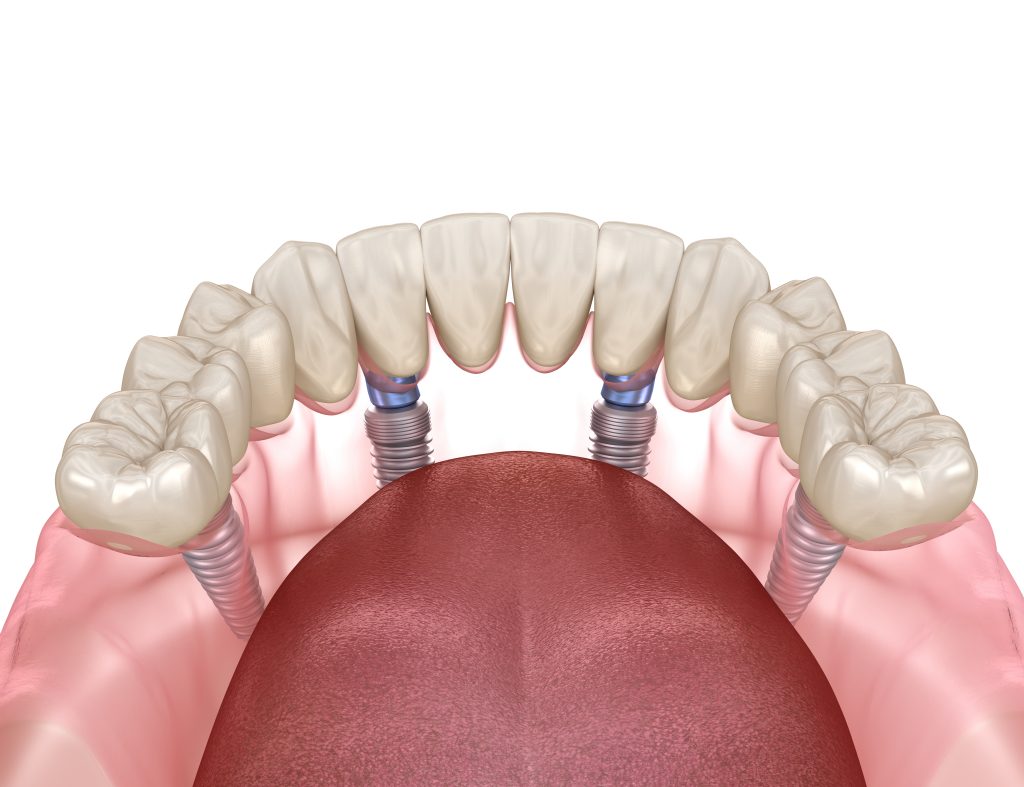
Four implants must bear every chewing force that passes through the jaw, every day. For that load to be distributed evenly and for the bridge to fit the implants without tension, every implant must land in exactly the right position at exactly the right angle.
Even a small positional error can prevent the bridge from seating passively on the implants. When a dentist forces a poorly fitting bridge into place, the stress applied to the fixtures and surrounding bone is known as the Crowbar Effect. Over time this causes:
- Bone loss around the implant body from excessive pressure.
- Loosening or fracture of the abutment screws connecting bridge to implant.
- Cracking or structural failure of the bridge framework.
- Repeated, costly, and painful corrective procedures.
Avoiding this outcome is why BFC Dental Implant Center invests in a complete Full Digital Workflow for every All-on-4 case.
Step 1: 3D CT Scan — The Foundation of the Treatment Plan
A conventional 2D dental X-ray shows a flat shadow. It cannot reveal the three-dimensional reality of bone depth, density, or the true position of anatomical structures. The 3D Cone Beam CT (CBCT) scan changes everything.
CBCT imaging produces a detailed volumetric map of the entire jaw: bone width, height, and density at every point; the precise location of the maxillary sinuses; and the path of the inferior alveolar nerve in the lower jaw. The dentist imports this data into planning software to calculate the ideal implant position, angle, and length for each fixture, keeping safe distances from the sinuses and nerve channels, and identifying zones of sufficient bone density that may allow implant placement without grafting.
Step 2: Intraoral Scanner — End of the Impression Tray
The traditional method of taking a dental impression, pressing a tray of setting material against the teeth and gums which is prone to distortion as the material shrinks on setting. At BFC Dental, a high-precision 3D intraoral scanner replaces this entirely.
A compact handheld camera scans the mouth and generates an accurate 3D digital model on-screen in real time. The digital model captures teeth, gum contours, and jaw architecture with no shrinkage, no distortion, and no discomfort for the patient. This data feeds directly into the treatment planning software alongside the CBCT scan data.
Step 3: 3D Guided Surgery — From Plan to Procedure
Digital planning is only valuable if the plan can be executed with the same precision. 3D Guided Surgery closes that gap.
Using the combined digital data, a custom 3D Surgical Guide is fabricated for each patient. This physical device fits over the jaw during surgery and physically constrains the drill to the planned angle, direction, and depth for every implant site. The guide makes it possible to place all implants through minimal incisions without opening a wide surgical flap which means:
- Significantly less tissue trauma during surgery.
- Reduced post-operative swelling and discomfort.
- Faster healing and recovery for the patient.
- The ability to place a fixed temporary bridge within 24 hours of surgery.
Step 4: Photogrammetry (Micron Mapper) — Implant Position Verification
Once implants are placed, the bridge must be fabricated to match their exact positions in three dimensions. For full-arch cases, standard intraoral scanning can accumulate small positional errors over long spans of the jaw. BFC Dental Implant Center addresses this with Extraoral Photogrammetry using the Micron Mapper system.
The process takes approximately 10 seconds:
- Scan Bodies (precision reference markers) are attached to each implant.
- The Micron Mapper photographs the jaw from multiple external angles simultaneously.
- The system calculates the exact 3D position of every implant at once, producing a spatial map accurate to within microns.
The result is approximately 10 times more accurate than conventional intraoral scanning across a full arch, meaning the bridge framework fits the implants with zero tension, eliminating the Crowbar Effect before it can begin.
Step 5: Digital Smile Design — Aesthetics Personalised to Your Face
Accuracy in implant placement addresses the clinical side. Digital Smile Design addresses the aesthetic side, ensuring that the new teeth look right for the individual patient, not just clinically correct.
The software analyses the patient’s facial proportions, jaw alignment, lip line, and smile arc. It simulates tooth shape, size, and arrangement on the patient’s own face on screen, before treatment begins. Patients see a preview of their new smile and contribute directly to the design decisions. This eliminates aesthetic surprises and ensures the final result matches both clinical requirements and personal expectations.
Step 6: In-House Laboratory — Speed Without Compromise
The final factor that enables teeth in 24 hours is BFC Dental’s in-house dental laboratory. Rather than sending designs to an external lab and waiting days or weeks for fabrication, the in-house team uses CAD/CAM technology and 3D printing to produce the temporary bridge on the same day as surgery. The bridge is ready and waiting when the patient wakes up from the procedure.
This in-house capability also means quality control at every stage is in the hands of the treating clinical team, not outsourced to a third party.
What the Full Digital Workflow Delivers for Patients
- Teeth in 24 hours (Immediate Loading): Fixed temporary bridge placed and functional the same day as surgery.
- Passive fit, zero Crowbar Effect: Precise positioning prevents the bone-damaging stress of a poorly fitting bridge.
- Safer surgery: Guided drilling avoids nerves, sinuses, and other critical structures. Minimal incisions mean less pain and faster recovery.
- Preserved jawbone: Evenly distributed chewing forces maintain bone stimulation and prevent long-term resorption.
- Personalized aesthetics: Digital Smile Design ensures the result looks natural and right for each individual face.
The Future of Full Mouth Dental Implants Is Digital
Modern All-on-4 full mouth dental implants are no longer based solely on surgical experience. Today’s best results come from combining clinical expertise with advanced digital technology.
At BFC Dental Implant Center, our Full Digital Workflow integrates 3D CT scanning, intraoral scanning, guided surgery, photogrammetry, Digital Smile Design, and our in-house digital laboratory to deliver precise, efficient, and predictable treatment.
For international patients travelling from Australia, New Zealand, the United States, and beyond, this technology helps make full mouth implant treatment safer, faster, and more comfortable while providing a natural-looking smile designed to last for many years.